The traditional office is more or less dead, at least for developers in 2026. In a field where a single poorly timed interruption can cost two hours of “flow state,” the workplace environment isn’t just about aesthetics; it’s about engineering productivity.
At Primarc Studio, we approach tech office design differently. Whether we are planning a boutique startup space in Gulberg Greens or a large-scale software house in Islamabad’s commercial hubs, our goal is to balance the “Maker’s Schedule” with the need for team collaboration.
Zoning for the “Maker’s Schedule”
In software development, there is a massive difference between a “Manager’s Schedule” (broken into 30-minute meetings) and a “Maker’s Schedule” (requiring 4-hour blocks of uninterrupted focus). A generic office layout kills the Maker’s Schedule. At Primarc Studio, we solve this by treating the floor plan like a User Interface (UI), it needs to be intuitive, low-friction, and partitioned by function.
The “Deep Work” Quiet Zones
For a developer, “flow” is a fragile state. Our approach to quiet zones goes beyond just telling people to be shushed. We design these areas to be the easy to use and make sense for your office, where the actual data is processed, and while designing we usually employ these techniques in our interior design.
1- Acoustic Buffer Zones: We don’t just use walls. We use “soft” transitions like bookshelves, acoustic felt panels, or greenery to absorb sound before it reaches the desks.
2- The 180° Rule: We position workstations so that developers aren’t facing high-traffic walkways. Reducing peripheral distractions is the easiest way to keep a team focused on their work.
3- Library Etiquette Interiors: While designing the interior design of the work space we intentionally use calmer cooler color temperatures (around 4000K to 5000K) and matte finishes to reduce glare on high-resolution monitors.
The “Collision Points” (Collaboration Zones)
Innovation and ideas rarely happens in a formal 2-hour meeting; it happens at the coffee machine or during a quick “hey, look at this bug” moment. We design Collision Points to keep these interruptions away from the quiet zones.
1- Stand-up Scrums: We create dedicated corners with high-top tables and no chairs. This keeps “daily stand-ups” fast, energetic, and literally on their feet, while giving them a platform to discuss their standing ideas as well.
2- Huddle Pods: Instead of booking a massive boardroom or meeting room for three people, we install semi-private “pods.” These allow for quick technical syncs without the overhead of a calendar invite.
3- Analog Brainstorming: Even in a digital world, nothing beats a physical marker. We integrate floor-to-ceiling whiteboard surfaces into the architecture itself often using back-painted glass that fits a sleek, modern aesthetic.
The Developer’s Ergonomics: Beyond the “Fancy Chair”
In a software house, the desk is the “cockpit.” If the ergonomics are off, you don’t just lose productivity-ively, you lose your best talent to burnout and physical strain. At Primarc Studio, we treat furniture and infrastructure as a single, integrated system. Most office designs treat “IT” as an afterthought, or focus too much on the wrong aspects of making it only ‘cooler and flashy.’ However for us something hidden under a desk in a mess of wires is not acceptable and thats how we go back to the drawing board again and again. We believe that for a tech company in Islamabad, your infrastructure should be as clean as your code.

Precision Ergonomics for High-Output Teams
A developer might spend 2,000+ hours a year at their station. We move beyond the “standard office chair” to create a setup that supports long-term health:
1- Dynamic Posture Support: We specify chairs with 4D armrests and synchronous tilt. Why? Because developers lean forward when debugging and lean back when reviewing. The chair must move with them.
2- The “Dual-Monitor” Standard: Our desk depths are a minimum of 30 inches (). This ensures that even with two 27-inch monitors, the user maintains the ideal focal distance to reduce eye strain. And make sure that the monitor arms also have ample space to assist in the mobility.
3- Sit-to-Stand Integration: We advocate for motorized sit-stand desks. Switching to a standing position for just 15 minutes every hour improves blood flow and mental alertness during that “3:00 PM slump.”
Infrastructure: The “Invisible” Design
At Primarc Studio, we say: If you can see a cable, the design isn’t finished. We have design custom raceways and “umbilical” cord managers that feed power and 10Gbps data lines directly into the desk frame to custom cord and mini pc holder under the desk. This keeps the floor and desk clear and the aesthetic minimalist.
1- Thermal Comfort & Airflow: Computers generate heat. We calculate the “heat load” of a fully staffed dev-floor and adjust the HVAC (Heating, Ventilation, and Air Conditioning) zones accordingly. No one can code efficiently if they are sweating or sitting in a cold draft.
2- High-Density Power Layouts: We don’t rely on wall sockets. We use floor-recessed power boxes or “power poles” that allow you to reconfigure the office layout in Gulberg Greens as your team grows from 10 to 50 people without ripping up the floor.
The Primarc Studio’s “Tech-Stack” Checklist:
[ ] Anti-Glare Lighting: task lighting combined with dimmable ambient layers.
[ ] Acoustic Desk Dividers: Using recycled PET felt to dampen the sound of mechanical keyboards.
[ ] Dedicated Server Cooling: Independent split-unit cooling for the server room to ensure 99.9% uptime.
The Islamabad Context: Light, Biophilia, and Local Aesthetics
Designing in Gulberg Greens, Islamabad or the Blue Area presents unique opportunities that a generic global firm might miss. We don’t just “put plants in a corner”; we use the natural environment of Islamabad to solve the biggest problem in tech: digital fatigue.

Harnessing the “Margalla” Light and Views
Software developers like almost other modern professions are spending their lives looking at backlit glass. The last thing they need is harsh overhead fluorescent lighting and sterile looking walls and decor.
Daylight Harvesting: We orient workstations to maximize northern light (which is consistent and glare-free) while using solar shading on southern windows to prevent heat gain during Islamabad’s intense summers.
Circadian Lighting: For teams working on “Global Shifts” (handling US or UK clients), we integrate smart LED systems that transition from cool white in the morning to warmer tones in the evening, protecting the team’s sleep cycles.
Biophilia: More Than Just “Greenery”
In a high-stress coding environment, “Biophilia” (our innate connection to nature) is a productivity hack. It lowers cortisol levels and boosts creativity.
Vertical Gardens as Dividers: Instead of drywalls and glass partitions, we use living green walls to separate the “Quiet Zones” from the “Social Zones.” These act as natural air purifiers and acoustic buffers.
Local Hardy Species: We specify plants that thrive in Islamabad’s humidity and indoor filtered light like Snake Plants or Areca Palms ensuring the office stays green without high maintenance costs.
The “Modern Raw” Aesthetic
To keep the look professional and “not too marketingy,” we lean into a Modern Raw palette that reflects Primarc Studio’s signature style:
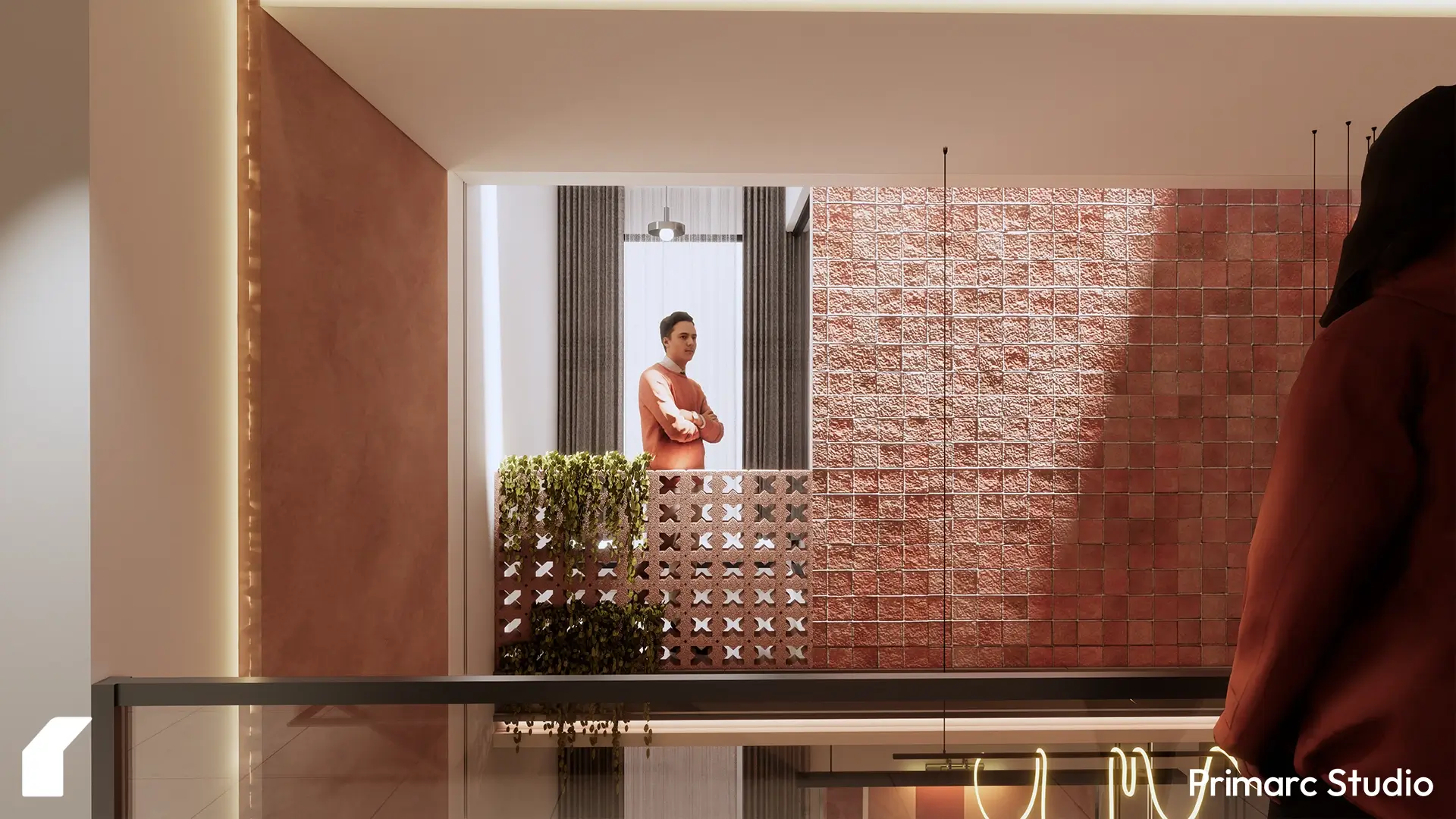
Textured Materials: We pair sleek glass and metal with warmer, local elements think fair-face concrete, reclaimed wood accents, or even traditional brickwork patterns used in a contemporary way. You can also view our design for technology company called ‘Tarteel Technologies’. Although its design is according to their culture and wishes you can see the same principals repeated there as well.
The “Anti-Corporate” Vibe: Tech talent in Pakistan increasingly prefers “Studio” environments over “Corporate” ones. We use open ceilings (showing the ducts and trays) but paint them a uniform dark charcoal to add height and a “loft” feel or incorporating the branding into the design and customizing the elements in that way.
Social Infrastructure & The Decompression Strategy
If your staff stays at their desks for 8 hours straight, their code quality drops. That’s why many companies encourage their developers to roam around after a focus session to reset the mind and make next session even more productive. We design Social Infrastructure that encourages movement and “forced” relaxation.

The “Café” Culture vs. The Canteen
We avoid the “industrial canteen” look. Instead, we aim for a Boutique Café vibe.
The Community Table: We often suggest one large, high-quality wooden table rather than many small ones. This forces different teams (QA, Dev, DevOps) to sit together, breaking down silos.
Acoustic Separation: The social zone must be physically or acoustically isolated. A loud espresso machine shouldn’t be heard in the “Deep Work” zone. We achieve this through heavy glazing or layout buffering (placing restrooms/storage between the two).
Power-Up Stations: Even in the lounge, we provide discreet power outlets. Sometimes, a change of scenery coding from a sofa for an hour is exactly what a developer needs to break a mental block.
Active vs. Passive Relaxation
Different people recharge in different ways. A good software house design provides both:
The Game Zone (Active): Whether it’s a Ping-Pong table or a PlayStation nook, these areas are vital for team bonding. We recommend placing these in the furthest corner of the office to contain the noise.
The Library/Zen Nook (Passive): For the introverted developer who needs 15 minutes of silence away from a screen. We use low-level lighting, comfortable lounge chairs, and zero technology in these small pockets.
The “Friday Demo” Space
Most Islamabad tech firms have a culture of weekly “Demos” or “Town Halls.”
Tiered Seating: If space allows, we design “stadium seating” or “amphitheater steps.” These serve as a circulation path during the day and a presentation theater on Friday afternoons.
Audio-Visual Readiness: We pre-install ceiling-mounted projectors and integrated speakers so that “setting up for a meeting” takes 30 seconds, not 30 minutes.
Future-Proofing: Sustainable Growth & Modular Design
The biggest waste of capital for a growing tech firm is a “hard” renovation every two years. We prevent this by treating the interior as a flexible kit of parts rather than a permanent set of walls.
The “LEGO” Floor Plan
We move away from fixed drywall and toward modular partitioning.
1- De-mountable Glass Walls: If you need to turn a large open space into two smaller “squad rooms,” our systems allow you to move the glass and doors in a single weekend without any dust or demolition.
2- Trench and Power-Pole Systems: We design a grid of power and data access points across the ceiling or under the floor. This means you can flip your desk orientation 90 degrees or add a new row of workstations without calling an electrician to “rip up” the floor.
Hybrid-Ready Spaces
Post-2020, the software house isn’t just a place to code; it’s a “hub” for a hybrid team.
1- Hot-Desking Infrastructure: We design “Touchdown Zones” lockers for personal items and unassigned, high-quality desks so that remote developers can plug in seamlessly when they visit the office.
2- Async-communication Nooks: We build and implement 1-person acoustic pods or “Phone Booths” specifically for Zoom/Slack calls. This prevents the “echo” of five different meetings happening in one open room.
Sustainability as a Business Asset
Modern tech talent cares about the planet. A “green” office isn’t just good for the earth; it’s a recruitment tool.
1- Energy-Efficient HVAC: We integrate smart thermostats that detect which zones are empty (like the boardroom on a Tuesday) and reduce cooling automatically.
2- Recycled & Low-VOC Materials: We prioritize paints and carpets that don’t off-gas chemicals. In a sealed office environment, air quality directly affects cognitive performance better air means fewer bugs in the code.
Conclusion: Engineering the Future of Work
The difference between a “pretty office” and a high-performance Software House is empathy understanding exactly how a developer, a designer, and a CEO move through their day. At Primarc Studio, we don’t view office design as a luxury; we view it as a critical component of your company’s “Tech Stack.”
A workspace in Islamabad should be more than just four walls and a row of desks. It should be a tool that actively reduces technical debt by fostering better communication, and a recruitment asset that attracts the top 1% of talent in Gulberg Greens.
By balancing the silence required for Deep Work, the infrastructure needed for 99.9% Uptime, and the Biophilic Aesthetics that keep teams healthy, we create environments where innovation isn’t forced it’s inevitable.
Why the Primarc Approach Matters
We understand that as a software leader, your focus is on the next sprint, the next deployment, and the next round of funding. You shouldn’t have to worry about whether your floor plan can handle ten new hires or if your server room will overheat in July.
When you partner with Primarc Studio, you aren’t just hiring an architect; you are hiring a team that speaks your language. We design for the Maker, we plan for the Manager, and we build for the Future.

Primarc Studio Architects
The Primarc Studio editorial team consists of architects and designers specializing in modern residential projects, interior designs and commercial designs across Pakistan. Together, we share insights on design trends, construction costs, and project case studies.